Featured

Assessment 2 Steps 7-9

Step 7: Cost Items

  1.  

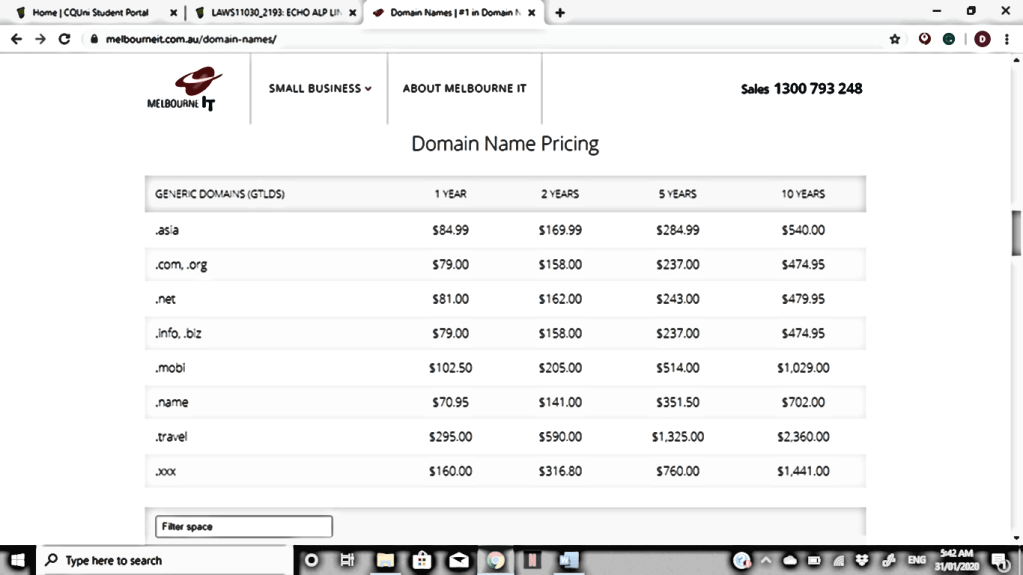
For my first item I chose the domain name registry, specifically the .net generic domain and for 2 years. A domain name is the identity string for the realm that the website is hosted in. for example ‘.com.au’ is obviously for Australian websites.

Domain name registry pricing: 2 years for $162.00 + $30 ongoing service fee p.a.
Variable costs = $30+$20=$50
Contribution margin = (162+30) – 50 =$14
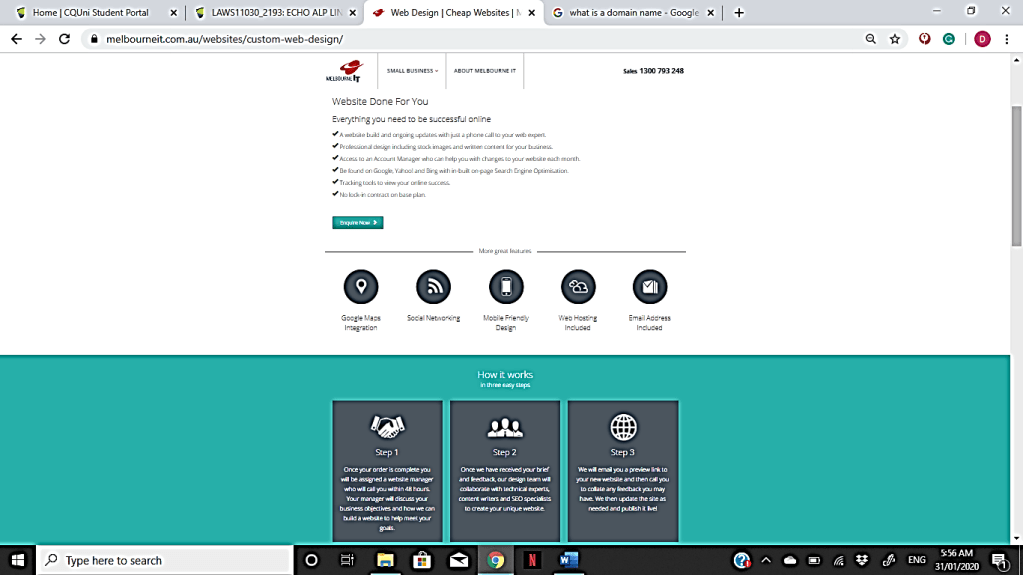
My second item is hard to find a price for, so I just googled how much it costs for a basic website build.

Website design: $500 + $20 ongoing maintenance fee
Variable costs = $300 + $10 = $310
Contribution margin = 520–310= $210
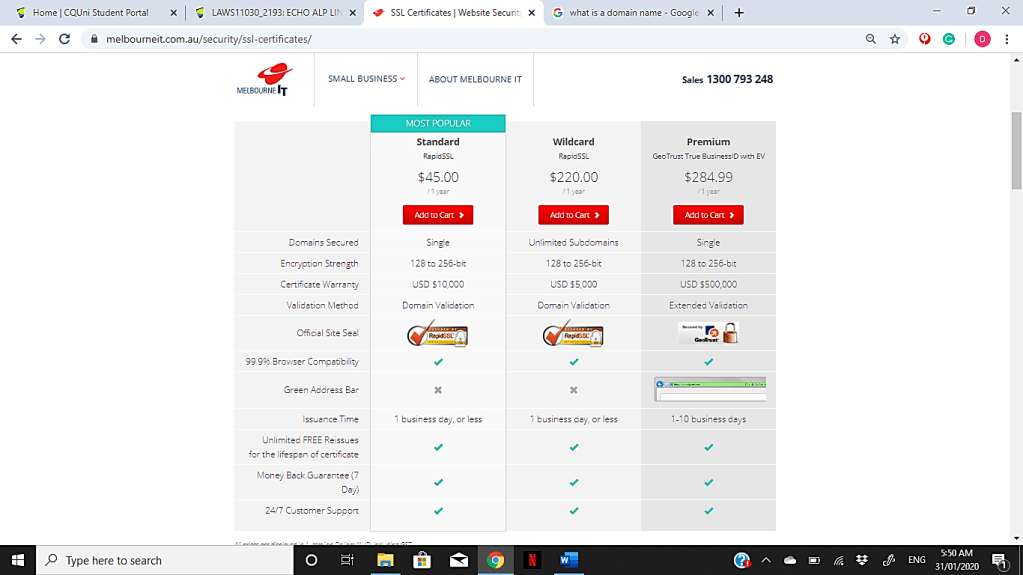
For my last item I chose to use the website security, I have opted for the most popular option at $45. It is the only item in my chosen, that doesn’t have an ongoing service fee.

Website security: $45 per year
Variable costs= $15 for labour on maintenance.
Contribution margin = 45-15= $30

Estimating or guessing how much the products of Melbourne IT would worth was challenging. Melbourne IT provide services, online services, which is something I have never even come across or had to use in my personal life. Luckily, after shifting through the website I managed to find how much they charge for ‘Website security’ and ‘Domain name registry’. I had to google how much it costs to have a website designed though, because they only had a quote option on the Melbourne IT website. I assumed that around $500, with and ongoing maintenance fee, for a medium range website build would be enough for this assessment.

As people don’t want to use multiple different services for their website design and build, Melbourne IT offer a one stop shop for all the design and hosting needs. It is the biggest benefit for tech companies, such as Melbourne IT because not many people understand how or what goes into building a website. The constraints that companies like Melbourne IT would face would also be in the fact that people don’t know what goes into the website design, meaning that consumers would be more likely to go to a company that charges less. Not only this but not understand why they need website security, would be another factor, especially, if they are not very tech savvy. My husband works for a big international company as an ATM Technician, recently they had a Russian Ransomware take over the whole company from Spain to Australia. If consumers don’t have sufficient security, it could have detrimental effects.

To me the contribution margin is the sum left after all the variable costs have been deducted. The contribution margin is where all the fixed costs must be deducted from, with the left-over amount being the sum of actual profit. Seeing as I don’t think that Melbourne IT would have many variable costs due to the services that they provide.

It has been tricky to separate the variable from the fixed costs for this company as the only variable costs I could think of is labour. All the other costs are licences, the computers used and electricity. Even when I estimated the variable costs and attributed most of them to labour alone, I’m not even sure if registering a domain name needs anyone to set it up or if it would even take much time at all. The reason that Melbourne IT would have quite similar variable costs is due to the nature of their services. They offer ongoing upkeep for a yearly fee. It would be quite like Telstra Broadband but without the inventory of modems. One of the benefits to providing services alone, would be that they would offer a few options for most of their services, like Telstra does. I noticed this for both the Website security and the domain name registry. This would be easier because once they sell these services, they know exactly how much profit, fixed and variable costs would be attributed to each one. Estimating the website build would be the problematic service. I am assuming that they would have a few basic options, where you could add specific items that you want to feature on your website. It would take a lot of consulting because people change their minds frequently and really have little to know idea what is involved in the service. One another note, the biggest benefit to providing services alone, is in the lack of inventory. Melbourne IT’s biggest expenses would be in the labour and quite possibly the top computers needed to service the tech support. The downside would be the massive amounts of cloud storage that would be needed to store the personal data of their clientele, also the very simple issue of natural disasters wiping out your electricity, software and cloud storage.

Step 8: Ratios

I personally didn’t find the ratios difficult to work out at all, I was very glad when I got to the end of Maria’s video and didn’t have to make sure everything totalled up correctly. The first thing that I have noticed about the ratios of my firm, is that they all follow a very specific trend. The company was improving gradually throughout all the years, except for 2018, this would be exactly the time when they merged under the ARQ Group. This has had a massive impact on the firm, and it is still too early to tell if it will be beneficial or detrimental in the long run.

Profitability Ratios
The net profit margin increased significantly from 8.6% up to 13%, in 2018 though it reduced rapidly down to -1.8%. The negative figure for 2018 is a concern, but with the merger that year it is difficult to tell if it is detrimental or just a probable outcome under the circumstances. Equally so, the Return on Assets also followed the exact same pattern, with an increase to almost 2% then an incredible drop to -0.7% in 2018.

Efficiency Ratios
There was no inventory that I could find for Melbourne IT and I am inclined to believe this because they focus solely on online services, it would be unlikely that they would carry inventory. I did read through the financial statements to be sure but could not find anything that appeared to represent inventory. The Total Asset Turnover has, on the other hand, increased for the year of 2018, it is only up by 0.05c but this is a completely different trend to the other ratio items. Total revenue did increase in 2018, as did the total assets. This is most likely because of the increase in total current assets for 2018.

Liquidity Ratios

Liquidity ratios have improved significantly over the years from the 0.55c per dollar to $1.08 per dollar of liabilities. This is a strong turn around and seems to be the only positive aspect in the ratios that has come from the merger. Having fewer current liabilities to current assets is promising however, I wonder if it might be attributed to the fact that the other companies that have come together under the merger carried more current assets over current liabilities. As, the merger saw 2 large companies come together and then buy or merge a lot of smaller companies underneath the ARQ Group, it is still too early to see if this is the case. It is highly likely that the smaller companies maybe have been in liquidation or not doing as well alone as they would under the ARQ Group.

Financial Structure Ratios
The financial structure ratios showed that the company holds a lot of debt in total liabilities, in relation to their assets it was almost consistent with over 100% debt. This was quite consistent throughout the last four years, with 2016 being the only year without over 100% debt. However, considering that the current assets to current liabilities ratio has improved to over 100%, Melbourne IT seems to be making improvements. Considering that the Liquidity ratios have improved significantly since the merger, it could simply be attributed to less current liabilities. Equity/total assets and Debt/total assets were almost even across all years, sitting at around 50/50 both ways, which isn’t the best, but the debt has improved from the 54% it was at in 2015 to 51% in 2018. Again, the lower liabilities in 2018 would be because of the lower current liabilities from the merger.

As Net Profit is down radically in 2018, it is not surprising that the earnings per share ratio was also down from 0.12 in 2017, to -0.02 in 2018, as the ARQ Group merger has combined in the ASX there are many factors that could be affecting this. On the other hand, the dividends paid out per share increased slightly and Melbourne IT seems to be trying to placate any uncertainty felt by their shareholders since the new merger, with increased dividend returns. The market price per share over the earnings per share has fluctuated, this could be due to share prices fluctuating, as the net profit over the number of shares remained steady for both 2016 and 2017. 2018 saw a staggering drop to (-180) from 23.61, indicating that the investment would be paid back in less than one year as opposed to the 23 years prior. This is a stark contrast to the decreased profit as a result of the ARQ Group merger in 2018.

Restated Ratios

Comprehensive income over shareholders’ equity was positive and like all the other items in the ratios, seemed to be getting better, in fact in 2015 the Return on Equity was at just 5% but increased to over 8% in both 2016 and 2017, until 2018 where it dropped to -1.43%. This is most likely because the profit for the year of 2018 was -2,326 and possibly due to the acquisition of the other groups under the merger, Outware and WME for example. Return on Net Operating Assets is down slightly from all the other years in the financial statements indicating that the Operating Income is still higher than the Net Operating Assets. In comparison to the Return on Assets from the original statements this is a much better outlook. It shows that Melbourne IT’s actual return on assets is much higher than previously indicated. Net Borrowing Cost ratio was significantly higher in 2018 at 13.53% the main driver behind this is the high amount of interest-bearing loans and the contingent consideration liabilities. In fact, most of the financial liabilities and obligations from 2018 can be the linked to the other companies taken under the merger. There were a lot of loans and debts accrued by these companies and the ARQ Group has had to acquire these. NFO from the restated financial statements is at 80k, where as NFE is (-10,825). 2017 was the best year for Net Borrowing Cost at 0.14%, exceptionally low cost, that would have benefitted the company. Melbourne IT’s Profit Margin is also down, but only slightly. The Profit Margin is still positive and considering the negative trend dominating 2018, this is positive. In comparison to the Net Profit Margin from the original financial statements, the positive percentage and the lesser drop from 2017, indicates that the company is doing better than previously apparent. Finally, the Asset Turnover. The Asset Turnover has followed a completely different trend to the entirety of the other ratios, except for the Current Ratio. Instead of becoming negative or less than previous years, the Asset Turnover that increased. It may have increased only slightly but considering all the other years and trends, this is seeming very beneficial, and indicates that sales and revenue have increased slightly. This could be a factor of the merge and simply due to an established base clientele and on-going contracts.

Economic Profit
Economic profit is a company’s revenue minus all the implicit and explicit costs involved in production. Explicit costs are those that are mostly unthought of but can be calculated, for example the cost of electricity to run the computers, the on-going maintenance costs for the computers and the rent on the company building. Explicit costs can be allocated a dollar amount and are easier to determine. An implicit cost is a little more difficult to calculate or to even comprehend. Also known as an implied cost, it is the opportunity cost accumulated when a business uses internal resources instead of explicit compensation. Or, in other words, it means the highest valued alternative that the company must sacrifice in order to produce something else. For example, the time spent manufacturing one product, that could be spent on a new project. Management will utilize explicit costs when reviewing a business’s operations, including profits; but will calculate implicit costs only for decision-making or choosing between multiple alternatives. For the average weighted cost of capital, I sifted through the financial statements and found a percentage to use. I am not entirely sure that I have found the correct figure, but it looked right to me. The fact that all of Melbourne IT’s economic profit is negative and worse in 2018 doesn’t bode well. Melbourne IT had a better year in 2016 but since the merger in 2018, has managed to increase the negative figure from 2017 by almost $6k. The higher negative for the economic profit in 2018 could very likely be attributed to the costs involved in the integration of the other lesser companies, like Outware and InfoReady. The implicit costs that could alter the economic profit, might be the time taken to complete the project, the other projects that would have been postponed and the management of any explicit costs accumulated by the businesses separately. The increased negative economic profit is not a good sign but likely due to the merger and it is too soon to determine if it will hinder the company in the long run.

In conclusion, the ratios show a different picture of Melbourne IT’s financial standing. For the most part in 2018 Melbourne IT is doing worse off than pervious years. however, since Melbourne IT’s finances were improving significantly in the years prior to the merge, it indicates a solid financial foundation and practices. After reading through the 2018 financial statements the customer contracts are down and the share price has also dropped. The uncertainty surrounding the merger is likely to blame. Revenue has increased by almost $100,000 in 2018, but EBITDA, dividends and underlying earnings per share have dropped. It is too early soon after the merger to determine the outcome of the company.

Step 9

As Melbourne IT recently merged under the ARQ Group, they have been looking to expand their software options by investing in some new projects. New software options will draw in a larger clientele base through different industries. For this assessment I will consider the two options, the first being facial recognition software and the second as real time bush fire mapping for the rural fire brigade. As these are all digital services there will be little in starting costs because it is highly likely that the company has the equipment and office space on hand already. However, because they are both projects that need to be developed over time, the negative costs initially will continue for longer. I assume these costs would include wages, licences and permits. I have decided on an initial investment and predicted that the residual value of these digital services would be higher than the initial investment because after stability, trust and reputation has been established, the software could be sold to another company or the highest bidder. For example, the bush fire-mapping would be incorporated by the rural fire brigade, but also receive incentives from the government for its development. As Melbourne IT is currently a smaller company that is in the process of expanding, I have also decided to use hundreds of thousands for the figures and maintain lower preliminary investments.
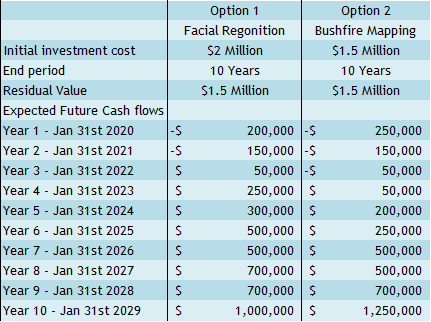
For my first chosen item, the facial recognition software I have chosen an initial investment of $2 million, mostly due to the equipment that may be needed for this specific type of software. As with any software projects it is unlikely to begin producing any income for quite some time, so I have opted to extend the negative figures for some years to allow for any software adjustments and developments, marketing and trust building that would be involved in getting a product out there. After a few years of negative amounts, it is highly likely that the software will be highly sought after and being to turn a profit quite quickly. Furthermore, I have also decided to have a high residual value at the end of the term due to the rarity and the value of developing new software such as this. It would be highly sought after and from what I can tell on the website, they are already developing something similar for ANZ and NAB in the coming years. This would bring in a high selling price at the end of the term. For the facial recognition, the NPV totalled to be $4.08 and the IRR is 12.3%, both are very promising figures. I have estimated that it would take around 8.07 years to payback the first investment and any subsequent costs involved in the development.

My second item of choice is the bush-fire mapping software. Like the facial recognition software, I have chosen to begin with more negative costs to begin with and to increase the profits quickly, this is because software like this is invaluable and would likely draw in government grants for development and more demand along the way. I have chosen a lesser starting investment of $1.5 million because it would require less equipment and legal protection. The bushfire mapping is also a prospective future project for the ARQ Group and like the facial recognition, is likely to hold a lot of residual value after the investment term is complete. The NVP for the bush fire mapping is $1.61 which is not as good as the facial recognition option, but it is still a positive amount and promising. The IRR totalled out to be 11.1%, which is just above the 10% discount rate and it would take 8.64 years to break even the initial investment.
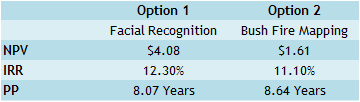
Overall the best option is for the facial recognition, even though it would cot more in the beginning, it would have a much higher return in the end. The NPV for the facial recognition option is much higher at $4.08 than the second option of just $1.64. The IRR for both options is close and over the discounted 10%, but the Facial Recognition is over 1% more. Likewise, both options have a similar payback period, with the Facial recognition getting paid off a few months sooner than the Bushfire Mapping. The facial recognition would hit the breakeven point earlier, would generate more profit overall and would sell for a higher amount when the investment term is complete. Of course, for investment decisions there would be a set time frame for the optimal payback period. The break-down of the primary investment cost, net present value (NPV), internal rate of return (IRR), and the payback period is a practical way for businesses to make constructive investment decisions for the future of the company.

Assessment 2: Step 1

KCQ’s Chapter 4.

As I get further and further into this unit, I am beginning to realise how much information is contained in a firm’s financial statements, and how it helps to paint a picture of the realities and possible future of a company. I have looked at financial reports before, but I will be honest in saying that I never really understood what I was looking at. I was more focused on the future goals, how long the CEO had maintained their position and if the CEO had benefitted the company or not, which in hindsight is just jargon that the company puts in to reel in buyers. I will admit that although my husband and I own shares in a few Australian companies, we chose these companies as either emotional buys or blue-chip, 100% franked with a dividend reinvestment plan.

Now that assessment 1 is out of the way, I am very eager to begin restating my firm’s financial statements. I really enjoyed entering the figures into the spreadsheet, the first time around. In all honesty, I have not been enjoying all the reflective writing, that’s not to say I don’t understand why it is essential, more that it is not something I enjoy doing. The spreadsheets were much more interesting, the idea that I can take any firms financial statements and the separate the operating and financial activities is a captivating possibility. Recently, in economics, I have been learning about the supply and demand curves of a firm and how different markets work concerning the scarcity of resources. It will be interesting to make connections throughout both units.

I was quite taken aback by the idea that I do not consider the opportunity costs involved in my own personal life and to be perfectly honest, it is true. I do not think about the highest valued alternative that I am sacrificing. Perhaps if we all spent some time reflecting on our own choices, we would all lead different lives. For example, the extra hour I spend watching Netflix or the weekends I go out partying instead of studying and putting in the effort into my assessments. In the long run, I guess It could be considered hindsight, but, if I actively spent the time looking at all my choices from here out, how different would my life be? It has been an insightful concept, and I intend to apply it to my everyday life. The difficulty with opportunity cost is that it isn’t always monetary, so how do you calculate the value of an opportunity cost. It seems that this would be difficult when calculating the economic profit.

The idea of capitol is not a new concept for me, I understand that companies need to invest wisely in order to make good returns, for both themselves and their investors. Afterall, as an investor you are in turn investing in the company with the expectation of returns through compounding interest from dividends. A few years ago, my husband and I were looking into buying investment properties and found that although we could build equity through paying off our mortgages, we could also build equity in capital. If I remember correctly, capital growth on properties is produced when the current value of the property is more than the amount you paid to purchase. This seems quite like capital gains of a company where the company invests in areas with the prospect of greater returns in the future.

All the different considerations and opportunity costs involved in a firm’s business dealings and future aspirations must be overwhelming. I guess It is like everyday life where you must make numerous decisions about yours and your families’ own future and weigh up all the costs involved. For instance, if you don’t eat well and exercise today you may not be as healthy as you could in the future. The same goes for career choices. For companies however, they must consider not only the future of the company, but also the future of their investors, equipment and workers. It must involve some very significant decisions, that could result in substantial consequences if not done correctly. When I consider all these variables, I can see why accounting is central to the firm’s future prosperity and success. After all, if I were to make the decision to go and gamble all my money away at the Star Casino this weekend, my whole family would suffer in consequence. However, if I took my money and invested it wisely into high dividend paying shares, my family would benefit in the future through possible passive income.

I have come to like the idea of restating my companies’ financial reports. To me, it seems as if it will be like doing my families budget, breaking up necessary, luxury and unforeseen expenses then subtracting that from our household income. The reference to the kinder surprise is an interesting one. I used to love kinder surprises as a child. Although I must admit, the novelty has worn off since having my own children and now being pestered to buy them. The further I read into this chapter, the more excited and increasingly nervous I am to begin restating my companies’ financial statements. All the information hidden in the statements is impressive, you just need to know where to look for it all. I also had no idea you could ‘see’ how well a firm is doing (or not doing) based on its ability to transfer equity from net operating assets and net financial assets. To me, it sounds like a big balancing act, the waiter or waitress who carries multiple plates of food or the acrobats at the circus. The idea of the family budget becomes more appealing to me because for us we can predict our future expenses and see where we could maybe cut back on some luxuries. So, in relation to my companies operating and financial assets, both the firm, the investors or anyone interested could do the same and predict the possible future financial standing of the firm.

A lot of the methods for restating financial statements contained in chapter 4 are confusing at this point, and until I begin restating my own firm’s statements, I won’t fully understand the processes involved. Mostly, I learn through doing and asking questions. I find it more beneficial if I hit roadblocks, where I must figure it out. Last semester I studied physics, for me, it was incredibly frustrating. I found that even after watching all the lectures, reading the study guide and making my own attempts, I was having a difficult time grasping the correct methods to work out the equations. However, I persisted. I watched YouTube videos and just practised whenever I had a free moment. In the end, I achieved a distinction and felt that all my hard work had paid off. I am hoping that restating won’t be as frustrating as physics, but at least I know to keep persisting and try to look at it from different angles.

The insight into profitability and efficiency is fantastic, I would never have thought you could break a company down into this much detail and get two percentage values on how the company is performing financially and its efficiency. It makes me eager to investigate other big businesses because, for the most part, the financial statements are just a distraction. If all companies stated their profitability and efficiency openly, many companies would look entirely different. I considered this to be like some people on social media, they project an image completely different to real life.

Overall this chapter has been a roller coaster of uncertainty, excitement and confusion. I am looking forward to getting into restating my companies’ financial statements next week. It will be exciting to see how well it is doing in profitability and efficiency, especially after the merger last year. I am eager to see if the merger has had an impact on the firm’s overall financial standing. My next move is to print out both the financial statements, begin a glossary of the acronyms and the numerous equations, and the study guide so that I can have them close for reference throughout the next step.

Assessment 1: Steps 2-5

Step 2: Links

Moodle account link: https://moodle.cqu.edu.au/user/profile.php?id=75898
Personal blog link: https://daniellas.school.blog/

Step 3: KCQ’s and My Company

Melbourne IT

An Australian company focused on providing excellent outcomes for small to medium businesses. Melbourne IT appears to have a long history, strong foundations and a demonstrated track record in delivering top tier cloud and data services to large government and corporate firms. I am interested in this company because I have not had much to do with website building and marketing in my personal or professional life.

Link to Melbourne IT website: https://www.melbourneit.com.au/

Melbourne IT helps businesses to build an online presence by creating, promoting and hosting websites, domains and social designs. Melbourne IT also provides website security, trademarks and do-it-for your website construction. I think Melbourne IT is such an innovative and futuristic company dedicated to helping busy business owners reach their marketing and online goals and, stay relevant in what is a technology-driven future. A lot of business owners might not be as tech-savvy and may struggle even to begin a website, let alone create a domain and market themselves through Google, Yahoo and Amazon.

2018 was a year of significant growth and change for Melbourne IT. In May 2018, the firm merged and re branded under the ARQ Group, now a group dedicated to providing a one-stop-shop for all online customer relations, design and marketing needs. ARQ Group help with data analysis and cloud storage. Under the new re brand, ARQ Group will now be able to offer digital services to all businesses, from small all the way through to large corporate and government organisations. Brands and services currently provided under ARQ Group include Outware, InfoReady, WebCentral and Domainz plus many more. Since the merge, revenue has increased by 8%, cash flow is up by 36%, and the company has just entered a three-year $142 million finance facility with both ANZ and NAB. When I realised that my company had merged under another company I freaked out and thought that it would change my financial reports a LOT, however, there were no changes to the financial statements at all. After my freak out, I went to the ARQ Group website to find out what they were about. It turns out that Melbourne IT and ARQ Group are very similar in the industry, where Melbourne IT provided online services for small businesses, that may be getting left behind in the technology ridden future, ARQ Group appears to have offered similar services for large and corporate companies. This do-over seems very fruitful for the future prosperity of the group, in the fact that all businesses can access these services under the one company allowing for more consumer diversity.

Link to ARQ Group: https://arq.group/

Further research outside of the Melbourne IT and ARQ Group website showed that at the end of 2017 Melbourne IT reported a net profit of $14 million after tax on revenue of $197.8 million. To me this seems like a massive ‘win’ and would suggest the company is doing very well. Although, at the same time it still held $54 mil worth of debt it does appear to be covered by their assets.

Before merging under the ARQ Group share prices were increasing steadily and dividends were being paid out at around 7 cents a share. ARQ Group’s share price has taken quite a drop since Aug 2018 from around $3.30 to 0.38 cents. This is a staggering drop in price considering that they have signed the three-year agreement with ANZ and NAB, had some notable projects in recent years and hold parentage over Melbourne IT and some other notable companies. Perhaps prices will rise in the future.

Notable projects this year include the development and launch of Linkt Go application for smartphones and tablets. Using GPS technology to accurately track when and where users enter and exit toll roads. In the first six months since the release of Linkt Go, the application has been downloaded more than 50,000 times and has won multiple awards. Personally, I have never used Linkt Go because I rarely travel through toll roads, but the few times that I have, it has always been a hassle having to set up your travel information and registration number to avoid getting late toll fees. I think this is a wonderful step into the future and it is exciting to see an Australian company behind it.

When I came to my companies’ financial statement, I was little overwhelmed by the sheer number of pages and detail contained within it. I had assumed it would just include the finances of the company and not future goals and leading staff roles within the company. Over the past five years, the company has grown each year significantly. According to the financial reports, there haven’t been any ‘bad’ years, and with the recent merger into the ARQ Group, it would seem nothing can slow them down. It looks like they have some big plans and goals to conquer in the coming years and the director, who has helped his position for over five years, seems very driven to achieving them. They have the right amount of equity and a diverse range of assets to cover the liabilities and more. Melbourne It had specific industry only expenses within their financial statements, for example ‘registry of domain names’ where the company both holds assets and liabilities.

Link to financial statements: https://arq.group/investor-centre/annual-reports

Overall, I have really enjoyed learning about Melbourne It and subsequently the ARQ Group. It is impressive to see the inner workings, goals and finances on just one company within Australia. I am looking forward to Assessment 2 where I get to discover their financial statements in a little more detail

Other student’s blogs:

The student blog that I have enjoyed the most is, Amy McClelland’s. Amy’s blog is a pleasure to read and she puts her own twist and sense of humour into her blog posts, which is refreshing. It is also nice to see another mother such as myself, heading back into study again after a long time out of school. I believe Amy is thorough in her analyse of the study guide and honest in her opinions and experiences. Her blog is a journey of discovery, her own personal touches of family photos and quirky quotes make it my number one.
Link to Amy’s blog: https://thedailyamy.home.blog/

The second student blog that I have found interesting is, Jewel’s. Jewel’s blog is neat and professionally laid out, the links to blog posts are easy to find. Her reflective writing is exceptional, and she is great at linking her personal experiences to her study guide chapters in her KCQ’s. Although Jewel was a little disheartened with her feedback from assessment one, she has taken it in her stride and isn’t letting it slow her down.
Link to Jewel’s blog: https://accountingisaccrualworld.news.blog/

Lastly, is Rebecca’s: I love her Indigenous art style background. I also appreciate that she is open and honest in her about me, she explains why she is coming back to university again to study. Rebecca is proud of her ancestry and involvement within the indigenous community, her little snippets of Indigenous language ‘kaya’ (hello) and yawore (goodbye) give the blog a more personal touch and open the way for cultural appreciation.
Link to Rebecca’s blog: https://becxsstudy.school.blog/

Studiosity review

I thought studiosity was an enjoyable experience over-all, I will use it again in the future. It was quick, having sent my draft in at around 9am and receiving feedback by around midday the same day is exceptional. I have 2 economics essays and a law case study coming up, and I intend to submit my assessments through Studiosity before final submission. My feedback was constructive; however, my draft was treated as an essay, so the comments I received were to do with structure and not having a thesis statement to begin all my paragraphs. Although I believe this to be important for academic essays, I have not used this style for my KCQ’s. Instead, I have used a more reflective and free-flowing thought style for my writing. In Conclusion, any future essays I have I will be sending them off to Studiosity, I don’t think you can ever have enough feedback on assignments and a new perspective could make all the difference in final marks.

Step 5 KCQ’s Chapter 2-3

I will be honest I have not been enjoying this unit much, I am finding that there is a lot involved and the sheer number of folders and requirements for the assessments is genuinely overwhelming. I am beginning to stress out that I am falling behind, and it is only the first assessment. Upon starting chapter 2 of the study guide, I was interested in discovering what kind of game accounting might be and the rules involved I never would have thought of accounting as a game of business, more a game of number manipulation. It seems to me that accounting, as with most companies, is about trust and the trust is maintained and upheld by specific laws and regulations. These laws and regulations are enforced by boards and authorities such as the Australian Accounting Standards Board (AASB) and the International Accounting Standards Board (IASB).

I am intrigued by how much my other units this term, Foundations of Business Law and Principles of Economics all are linked to this unit and presumably future units. For instance, through business law, I am learning how the law works, where to find it and how to interpret it and for economics, I am learning about the trends of supply and demand and how firms make financial decisions based on the data they have. Integrating my current learning into the different units is fun and is making it a lot easier to understand the key concepts involved. An example from this unit would be the ‘rules’ around the Corporations Act. Because I am studying business law, I know where to find the Corporations Act and interpret what it entails. What I have also found interesting is the supposed unwritten rules surrounding accounting practices. I believe this will be something I grasp later in my degree.

It seems to me that the game of accounting it all about making connections, either through financial statements, professionally or networking. My husband is currently in the process of a career change, studying to become a mortgage broker. Something he has learnt recently is that ‘an accountant is a mortgage brokers best friend’ mainly due to the unending networking and personal interactions involved in accounting. Due to this, an accountant can often refer to multiple clients, from all walks of life to a mortgage broker. How exciting.

The notion that firms are restricted by rules set out by authorities in their own countries is a strange concept to me. I can fully understand the fundamental need for local governing bodies. However, it leaves a lot of room for unethical practices for international firms or even local firms that keep offshore accounts and records. I remember seeing quite a lot of this in the media over the years, and it is fascinating that it is still common practice. Perhaps there should be an entirely separate international authority that decides and enforced a set of universal rules and regulations to ensure all big corporations act within a certain standard. This is just my thoughts anyway.

The idea that reading the financial statements of a company is like getting to know someone new is a creative way of thinking about it. So much so that it has made the whole process less daunting than reading 50+ page booklet of numbers and future goals. The concept of Chris and Sarah gives the topic of financial statements a fun edge in what could be an unriveting topic. Before reading the third chapter, I was feeling very overwhelmed at the prospect of having to shift through all the pages in the financial statements to find the information I needed to complete my assessment. I was especially taken aback by the endless number of footnotes that all link to items within the financial statements I would be using. Would I have to read all the notes? Would I have to put these into the end of the spreadsheet? Martin’s explanations of what all the four financial statements entail and what they are used for has given me a better understanding of what the game of accounting is about. It is clear to me why the financial statements are essential to investors, who are looking to make the best investment for the future, with their money. Unlike Martin’s company Ryman Healthcare, my company was a singular entity until 2018, when it merged under a parent group called ARQ Group. The idea that companies can oversee or be the parent to such staggering amounts of other smaller companies is quite bewildering. For me, having an objective view while reading through my firm’s financial reports has helped me to gain a realistic perspective of the personal characteristics of my firm, and it has given me an interesting vantage point of how different firms have diverse expenses, unique to their industry. A little like job skills.

I personally have never been interested in starting my own business, in fact, accounting is the closest I have come to try to understand the inner workings of companies., a concept that was quite a shock to me. Although I have worked for both small and international companies alike, I have not thought about what it must be like to juggle and oversee so many aspects all at once, to keep the business running smoothly. The numerous assets held by each company is fascinating to me. And, the diversity of some of these assets is equally impressive, anything from cash to property to shares. Overall, to me, the assets are like leverage for the firm, a back-up if you will, to ensure future security if it should fall on hard times.

Assessment 1: Step one

Accounting. What is it? I have been pondering this exact same question for about 2 months now, ever since I chose to change my study plans, from a Bachelor of Sonography to a Bachelor of Accounting. I made this sudden change because of 1. I want to be around for my three children while they are still young, 2. I would have to move myself and my family away from our entire support network and 3. Accounting would allow me to earn a decent wage with the opportunity of career advancement. However, what I didn’t know is how accounting plays a crucial role in all businesses. I assumed I would spend my professional career crunching numbers at a small desk, in an office and be completely miserable. But at least I would get to enjoy my kids, right? Seemed like a worthy sacrifice to me. It seems I was wrong. Martin Turner has piqued my curiosity with his depiction of what else accounting has to offer. The fact that accounting is a foundation in all businesses, some of Australia’s top CEO’s have backgrounds in accounting and that accounting could cultivate the kind of passion Martin has in teaching it.

I have been feeling overwhelmed with the number of steps in each assessment for this unit. Having to start PeerWise, a Moodle bio, a blog and begin writing Key Concepts and Questions all within the first week is a little daunting, especially on top of other units. The help available within the Introduction of the Study Guide is comforting and has stifled some of these feelings. Without them, I may well have left some of the starting steps to a later date, but Martin’s reasoning as to why they are essential has changed my mind. Since completing the Introduction and Chapter 1 in the 2 weeks before term started, I have done all the steps and even begin asking and answering questions on PeerWise.

The in-depth overview of learning has been really thrilling to read, it is shocking considering I thoroughly believed all the reading material in accounting would be dry and unstimulating. I am genuinely excited to learn by doing, I have always loved learning particularly new people, ideas and how things work, everyone has such different views of the world, and it is intriguing to learn about someone else’s. The six categories of learning are a delightful way of defining what it is fundamentally, considering it is such a personal experience for everyone.

Simultaneously, I am nervous about having to interact with others so much, in this unit, I haven’t had a lot of experience connecting with other students online at university. Although, I have spent most of my life around computers using social media, connecting through university will be an entirely new experience. As a parent and a mature student, the part of online communication that I love the most is the ability to sign on and connect at a time that suits me. My time is minimal, and the ability to attend to my study, social and work obligations at a time that suits me is exceptionally beneficial.

The beginning of chapter 1 finds me questioning. Previously I had assumed accounting was simply playing with numbers and tax logistics, now I am becoming more interested in what else may be achievable. The few chapters I have read have been exceptionally well written and engaging. The sections have covered many unexpected aspects; from ‘What is Learning’ to ‘Accounting is a foundation of a business’. It is refreshing to read the chapters as they flow neatly from someone who is clearly passionate about the art of teaching, learning and the inner workings of a business. It is clear from the readings that Martin has been studying and teaching various aspects of accounting and business foundations for quite some time now, making him a true master of his craft. My assumptions were later confirmed as I read about his Ph D thesis on ‘How to support students studying accounting at university to not just look at numbers as being some sort of ‘answer’ or reality themselves but to see why we use accounting information to seek to engage with what is really going on in a business’.

The frequent questions throughout both first chapters have left me pondering and questioning my own thoughts and ideas surrounding accounting, business and even learning. Never would I have thought that introductory accounting would be so philosophical and reflective. One of the critical pieces of information I have taken from this second chapter is that accounting plays a crucial role in business and, it can either add significant value or hinder a company.

While I believe that many companies are created to add or create value in both personal lives and the lives of others. I also think it can be fuelled by monetary gains, even though this would add value to one’s own life, it would be at the expense of others. For example, the current rise in drop-shipping. The creators of these online businesses are selling products that sellers may not know the quality of. Furthermore, the buyer of these products has made a conscious decision to purchase the products, there is an air of inequality to this business model. Primarily when the products are sourced from third world countries, they seldom know where the products originate from, if the resources are reliable and if the manufacturers of the goods are treating workers fairly.

The concept of double-entry accounting is new for me, and the idea of debit and credit is new and confusing. I believe this is because it is something I have not studied before, coupled with the fact that credit is calculated using negative numbers while debit uses positive numbers is quite hard to grasp this early on, even with Martin’s clear explanations and concept mapping. Reading about the history of double-entry accounting is fascinating, and it has helped me to understand how even in its primitive form used centuries ago, it was still a fundamental aspect of a business. The in-depth history of double-entry accounting has allowed me to understand the basics, by understanding how it was first applied, how it has developed over the years and what aspects have remained unchanged even after all this time.

In conclusion, the first to chapters of the study guide have been a journey of learning and discovery. The frequent questions and personal references throughout have helped me to connect with both myself and the author on a personal level. Helping me to memorise and process all the complex concepts and ideas, in the somewhat confusing time that is the start of term. The explanations as to how we learn, what accounting and business are and how as accountants we must understand the concepts involved so that we can help add value to any businesses we may become a part of in the future have been of great benefit to me overall. Lastly, I am looking forward to the rest of the term and beginning to really understand the inner workings of accounting.

Melbourne IT

A company focused on providing excellent outcomes for small to medium businesses. Melbourne IT also has a rich history, great legacy and a proven track record in delivering the very best cloud and managed services to large government and enterprise clients.
Melbourne IT helps companies to build an online presence by creating, promoting and hosting websites, domains and social designs. Melbourne IT also provides website security, trademarks and do-it-for your website builds. I think Melbourne IT is such an innovative and futuristic company dedicated to helping busy business owners reach their marketing and online goals and, stay relevant in what is a technology driven future. A lot of business owners might not be as tech savvy and may struggle to even begin a website, let alone create a domain and market themselves through Google, Yahoo and Amazon.


2018 was a year of significant growth and changes. In May 2018, Melbourne IT merged under the ARQ Group, a group dedicated to providing a one-stop shop for all online customer relations, design and marketing needs. Under the new merge, ARQ Group will now be able to provide digital services to all businesses, from small all the way through to large corporate and government organisations. Brands and services now offered under ARQ Group include Outware, InfoReady, WebCentral and Domainz plus many more. Since the merge, revenue has increased by 8%, cash flow is up by 36% and the company has just entered a three year $142 million finance facility with both ANZ and NAB.


Notable projects this year include the development and launch of Linkt Go application for smartphones and tablets. Using GPS technology to accurately track when and where users enter and exit toll roads. In the first 6 months since the release of Linkt Go, the application has been downloaded more than 50,000 times and has won multiple awards. Personally, I have never used Linkt Go because I rarely travel through toll roads, but the few time that I have, it has always been a hassle having to set up your travel information and registration number to avoid getting late toll fees. I think this is a wonderful step into the future and it is exciting to see an Australian company behind it.

You can find Melbourne IT at https://www.melbourneit.com.au/

Design a site like this with WordPress.com
Get started